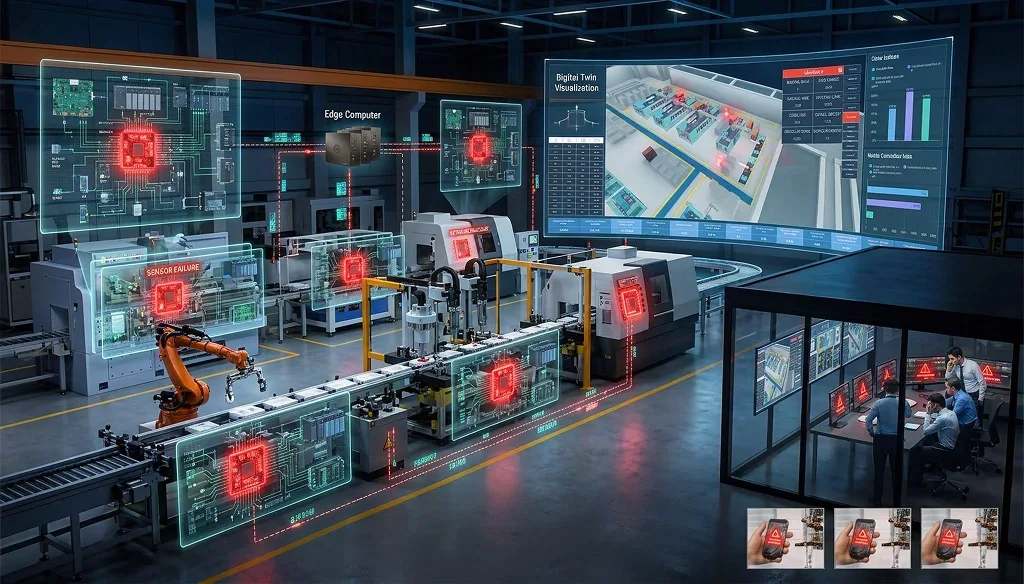
For decades, innovation in manufacturing focused on machinery, logistics (assembly lines and production chains included), and enterprise software. The operational efficiency of industrialised environments gravitates towards the hardware and embedded systems that connect machines, sensors, and decision logic.
These systems determine:
- how quickly defects are detected;
- how efficiently machines communicate;
- how secure industrial infrastructure remains;
- how easily factories adapt to new production requirements.
When this level of operations is poorly designed or obsolete, the consequences rarely appear as a single ruinous failure. Instead, they build up quietly and jeopardise entire work cycles, which leads to higher data costs, slower production adaptation, cybersecurity exposure, and compliance delays.
By 2026, manufacturers that treat hardware architecture as a strategic capability will significantly outperform those relying on legacy embedded stacks. Modernisation and optimisation are here to stay, and this fact alone should compel manufacturers to thoroughly review where they are losing money, because their survival on the market depends on it.

1. Cloud Overdependence and Rising Data Costs
The first wave of Industry 5.0 urged manufacturers to push operational data into centralised cloud environments. While cloud analytics remains important, sending every sensor reading and machine signal upstream creates two structural inefficiencies:
- increasing bandwidth and storage costs;
- slower response times for operational decisions;
- escalating security concerns.
Factories generate enormous volumes of machine data every second, and processing all of them in a host-based system quickly becomes expensive and inefficient.
Modern manufacturing architectures are shifting toward edge-native intelligence, where embedded systems process data directly at the source. Instead of streaming raw data continuously, edge devices send only actionable insights to centralised systems. For large manufacturing operations, this shift can reduce cloud-related infrastructure costs by 30–40% while improving decision speed on the production floor.
2. Late Detection of Quality Defects
In many factories, quality inspection still happens after production steps have already been completed. This delay creates a dangerous multiplier effect: by the time a defect is detected, hundreds or thousands of units may already be affected.
Modern embedded vision systems change this dynamic entirely: for instance, by using AI-powered industrial cameras deployed directly on production lines, manufacturers can detect:
- assembly inconsistencies;
- surface defects;
- packaging errors;
- dimensional deviations.
This results in faster detection cycles and considerably reduces material waste. In certain production environments, real-time inspection increases throughput while decreasing defect-related losses by more than 25%.
3. The Cost of Slow Production Retooling
Manufacturers face unprecedented market volatility nowadays. Demand patterns shift quickly, supply chains change, and new product iterations appear constantly. Many factories still operate on hardware architectures designed for static production models, though.
Traditional PLC-based systems often require manual reconfiguration and extensive engineering effort to adapt production lines. This creates the industrialisation gap, the difference between what engineers can design and what factories can realistically deploy at scale.
Software-defined industrial hardware addresses this challenge. Instead of rebuilding control systems, manufacturers can update production logic through firmware updates and programmable control platforms. In practice, this approach can accelerate line reconfiguration by up to 70%, dramatically improving operational agility.
4. Cybersecurity Vulnerabilities at the Device Level
Historically, industrial cybersecurity has focused on networks and IT systems. However, modern attacks increasingly target embedded devices. Compromised firmware, insecure device boot processes, or manipulated hardware identities can allow attackers to infiltrate industrial infrastructure.
In manufacturing environments, a major cyber incident can trigger:
- plant shutdowns;
- intellectual property loss;
- safety incidents;
- regulatory penalties.
Industry estimates suggest a single enterprise breach can cost over $5 million when operational disruption and recovery costs are included. This is why modern industrial devices increasingly incorporate hardware Root of Trust (RoT) technologies that ensure secure boot processes and tamper-resistant device identities.
5. Compliance Bottlenecks in Regulated Markets
Manufacturers entering industries such as aerospace, pharmaceuticals, and energy face stringent regulatory requirements. Many companies underestimate how tightly these requirements are tied to the progression from cause to effect in hardware within architecture decision frameworks.
Security, traceability, and update mechanisms must often be built into devices as early in the process as possible. When compliance considerations appear late in the development stage, companies are forced to redesign core systems, delaying product launches and increasing expenditures. With the help of legacy architectures, manufacturers can integrate compliance-ready hardware platforms in the beginning and enter regulated markets months earlier than their competitors.
The Hardware Trends Redefining Manufacturing in 2026

Several technological shifts are reshaping industrial architecture, and understanding these trends helps manufacturing leaders anticipate with greater precision where strategic modernisation will deliver the highest return.
Edge-Native AI
Artificial intelligence is moving from centralised cloud systems to embedded devices located directly on factory floors. Edge-native AI allows machines to:
- detect anomalies instantly;
- optimise operational parameters;
- react autonomously to changing production conditions.
For manufacturers, this suggests faster operational decisions and less network latency.
Software-Defined Industrial Hardware
Industrial infrastructure is increasingly becoming software-configurable. Control logic that previously required specialised hardware can now run on flexible embedded computing platforms. This allows manufacturers to adjust production processes through software updates: once made malleable, manufacturing continuity no longer requires hardware replacement.
Open Hardware Architectures and RISC-V
Many industrial hardware platforms historically depended on proprietary processor ecosystems. Open architectures, such as RISC-V, change the established model by enabling companies to develop custom silicon solutions without licensing restrictions. For manufacturers, this offers:
- supply chain independence;
- hardware customisation for specific workloads;
- elimination of recurring royalty fees.
Together, these advantages give manufacturers greater control over their strategy, technology stack, and supply-chain resilience while reducing dependence on proprietary vendors.
Hardware-Level Cybersecurity
Security is shifting toward hardware-anchored protection mechanisms, whereas technologies such as Root of Trust enable hardware’s effortless firmware integrity verification during boot processes and prevent unauthorised modifications. These capabilities are becoming mandatory as regulations increasingly require security-by-design in connected industrial systems.
Ultra-Low-Power Industrial Devices
Modern factories may deploy thousands of sensors across equipment, facilities, and logistics systems. Maintaining these networks using replaceable batteries can quickly become expensive and operationally complex. New sensor technologies use energy harvesting — capturing power from vibration, heat, or ambient light. This allows sensors to operate for years with minimal to no manual maintenance.
Hardware & Embedded Solutions That Address Real Manufacturing Needs
Modern manufacturing environments rely on several categories of embedded systems. Below, we have compiled for you the most common solution types and the business problems they address.
Edge Intelligence Systems
Edge computing platforms bring AI directly to production environments to secure order, structure, and consistency.
- Edge AI Vision Systems
Used for automated quality inspection on production lines.
Example: An automotive manufacturer deploys embedded vision systems to inspect weld quality and paint surfaces in real time, preventing defective vehicles from progressing through assembly.
- Predictive Maintenance Nodes
Sensor-equipped embedded devices installed on industrial equipment monitor vibration, temperature, and acoustic patterns.
Example: A food processing facility uses predictive maintenance sensors to detect early signs of bearing failure in conveyor systems, preventing costly production downtime.
- Autonomous Mobile Robot Controllers
Embedded computing platforms that power autonomous mobile robots used for internal logistics.
Example: Electronics manufacturers increasingly use AMRs to move components between production stages without manual transport.
Industrial Computing & Control Platforms
These systems manage machine coordination and production logic.
- Virtual PLCs
Software-based programmable logic controllers that run on industrial computing platforms. This allows manufacturers to update production control logic remotely rather than replacing hardware controllers.
- HMI (Human-Machine Interface) Panels
Embedded interfaces that allow operators to monitor machine performance and interact with industrial systems in real time. Modern HMIs integrate advanced analytics and predictive alerts.
- Time-Sensitive Networking (TSN) Gateways
Industrial communication networks require precise timing coordination. TSN gateways enable deterministic communication between machines — critical for robotics and synchronised manufacturing processes.
Connectivity & Industrial IoT Infrastructure
Connectivity infrastructure is the pillar of digital manufacturing environments, when industrial data is its lifeblood (when we narrow this concept down to Industrial Internet of Things, connectivity comes in as a paramount factor).
- Secure Edge Gateways
Industrial gateways collect machine data locally and forward relevant information to enterprise systems while maintaining strict security controls.
- Private Industrial 5G Networks
Private wireless networks provide ultra-low latency connectivity across large manufacturing facilities. This infrastructure supports mobile robots, automated vehicles, and high-bandwidth sensor networks.
- Energy-Harvesting Sensor Networks
Battery-free sensors capture environmental and equipment data without requiring regular maintenance, especially valuable in large facilities where thousands of sensors may be deployed.
Safety & Compliance Hardware
Industrial safety and regulatory compliance increasingly depend on specialised hardware systems.
- Functional Safety Modules
Embedded systems designed to meet strict safety standards in critical industrial operations.
- Safety-Critical Real-Time Operating Systems (RTOS)
These operating systems ensure deterministic behaviour in environments where timing precision and reliability are essential. They are widely used in aerospace, robotics, and medical equipment manufacturing.
- Intrinsically Safe Embedded Systems
Certain environments — such as chemical plants or energy facilities — require devices certified for operation in explosive atmospheres. These specialised embedded systems prevent ignition risks.
- Automated SBOM Generation
Modern regulations require manufacturers to maintain Software Bills of Materials documenting all software components used in connected devices. Automated SBOM generation tools simplify compliance with cybersecurity regulations.
Compliance as a Hardware Design Issue
Regulatory frameworks increasingly require manufacturers to integrate security and traceability directly into connected products.
Key standards include:
- EU Cyber Resilience Act (CRA) — requiring security-by-design for connected devices.
- IEC 62443 — industrial cybersecurity standard mandating secure firmware updates
- ISO 27001 and ISO 9001 — frameworks supporting secure and high-quality operational processes
For manufacturers entering international markets, compliance can be both a legally-binding regulatory requirement and a reality check. Once companies that design hardware architecture treat this legislation as a competitive advantage and abide by specific directives, they can bring products to markets faster and avoid costly redesign cycles.
From Technical Layer to Strategic Advantage
For many organisations, embedded systems were historically treated as a technical detail managed by engineering teams. In modern manufacturing, they are a strategic capability and an asset.
Companies that invest in advanced hardware architectures gain:
- faster production adaptation;
- lower operational costs;
- stronger cybersecurity resilience;
- easier compliance with emerging regulations;
- greater control over technology supply chains.
Most importantly, they start adapting quickly to changing markets.
Where to Start
For many manufacturing companies, the biggest challenge is understanding where modernisation will deliver the greatest impact first. A structured assessment typically focuses on:
- existing industrial hardware architecture;
- opportunities for edge AI in production lines;
- industrial connectivity infrastructure;
- cybersecurity readiness at the device level;
- compliance alignment with upcoming regulations.
These insights are deduced from opportunities to reduce operational costs and increase production agility.
The Bigger Picture Revisited
Manufacturing leaders invest heavily in software platforms, analytics tools, and automation strategies. The systems that ultimately determine how efficiently those technologies operate are embedded deep inside machines, sensors, and industrial infrastructure. Ignoring this layer means leaving efficiency, security, and agility on the table, whereas modernising can unlock technology’s potential.
If you are exploring how hardware and embedded architecture can improve operational efficiency in manufacturing (e.g., structuring discovery or optimising architecture), an audit is often the best starting point.
If you are pondering how embedded systems can strengthen your manufacturing infrastructure, UnioTech can be a trusted partner in navigating the complexity of modern embedded software development.