
Healthcare: Reliable Devices for Data-Driven Care
Healthcare technology depends on trust, accuracy, usability, and continuity. Medical and healthcare devices must capture signals reliably, process data predictably, protect sensitive information, and support clinical, home-care, and patient-facing workflows without creating unnecessary complexity.
Yet many healthcare products face similar challenges: fragmented device data, limited remote visibility, delayed response to abnormal readings, poor usability, unreliable connectivity, and difficulty moving from an early prototype to dependable, deployable hardware.
Hardware and embedded software form the execution layer of modern healthcare technology. They connect physical processes with sensing, control, communication, local intelligence, diagnostics, and secure device lifecycle management.
UnioTech supports healthcare product teams with embedded hardware, firmware, sensing, connectivity, device interfaces, diagnostics, validation support, and secure connected-device architecture.
Where Visibility, Reliability, and Control Are Lost
Healthcare technology projects often lose efficiency and reliability when:
- patient-related and device-related data remain fragmented across separate systems;
- abnormal readings, device faults, or connectivity issues are detected too late;
- data flows between devices, clinicians, caregivers, and digital platforms are poorly integrated;
- hardware is difficult to service, validate, scale, or prepare for manufacturing;
- user interfaces create unnecessary complexity for patients, clinicians, or caregivers;
- firmware security, diagnostics, and update mechanisms are considered too late in development;
- prototypes are created without a clear path toward testing, production, and long-term support.
A well-designed embedded architecture addresses these challenges at the device level by coordinating electronics, sensing, firmware, connectivity, diagnostics, security, and lifecycle planning within one system.
1. MedTech & Medical Devices
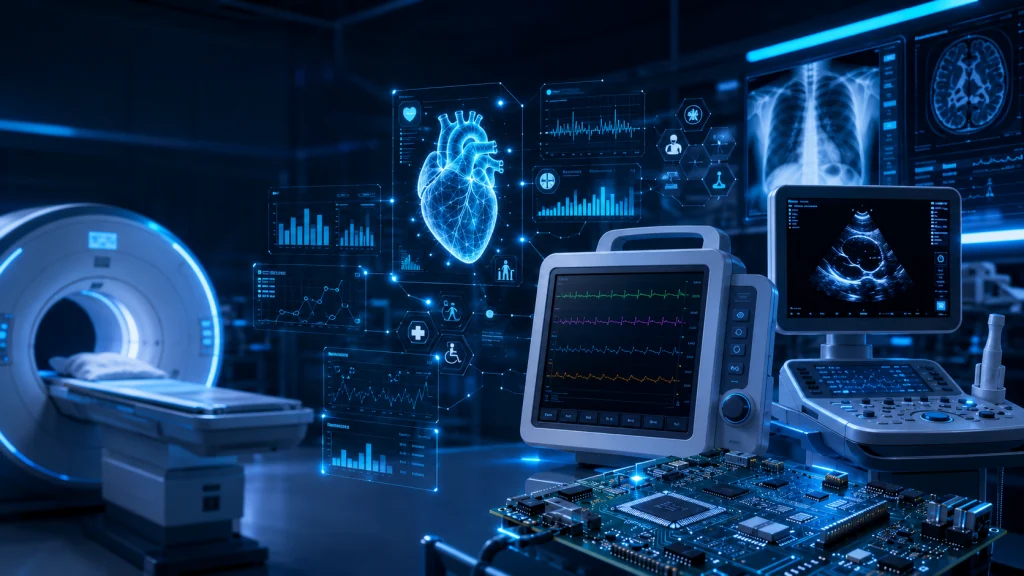
This domain covers embedded electronics, control platforms, sensing, power systems, and user-facing subsystems used in medical and clinical equipment.
Medical devices require more than reliable individual components. Sensors, processing units, power electronics, communication interfaces, safety mechanisms, and user controls must operate together predictably.
The architecture should support repeatable performance, clear diagnostics, maintainability, and preparation for applicable technical, validation, cybersecurity, and regulatory requirements.
Diagnostic & Imaging Systems
Diagnostic and imaging equipment depends on accurate signal acquisition, coordinated control, dependable data handling, and responsive operator interfaces.
Embedded subsystems may be used to:
- acquire and process sensor or imaging data;
- control scanning, positioning, timing, or triggering functions;
- coordinate electronic and mechanical subsystems;
- manage communication between device modules;
- support operator displays and controls;
- record device status, faults, and diagnostic information.
These systems often combine real-time control, embedded processing, high-speed interfaces, signal integrity considerations, and safety-oriented behavior.
Therapy & Rehabilitation Electronics
Therapeutic and rehabilitation devices require precise, controlled, and repeatable interaction with the user.
Typical engineering tasks include:
- controlling motors, actuators, heaters, pumps, or stimulation subsystems;
- integrating position, movement, pressure, force, or physiological sensors;
- implementing operational limits and fault monitoring;
- creating intuitive controls and feedback mechanisms;
- collecting therapy-session or device-performance data;
- supporting calibration, maintenance, and diagnostics.
The embedded system must coordinate sensing, actuation, user interaction, and fault handling as one reliable control architecture.
Portable Medical Devices
Portable and handheld medical devices must combine compact dimensions, battery operation, dependable sensing, connectivity, and safe user interaction.
Depending on the application, the device may include:
- low-power sensor acquisition;
- embedded signal processing;
- a local display or simplified HMI;
- battery charging and power monitoring;
- wireless or wired data transfer;
- local data storage and buffering;
- secure firmware updates;
- self-test and diagnostic functions.
Power consumption, enclosure limitations, antenna placement, durability, usability, and serviceability should be considered together from the beginning of development.
Embedded Control Platforms for Medical Equipment
Medical equipment often requires a central embedded platform that coordinates sensors, actuators, communications, safety functions, and user workflows.
A control platform may include:
- microcontroller- or processor-based electronics;
- real-time firmware or embedded Linux;
- modular sensor and actuator interfaces;
- wired and wireless communications;
- fault detection and data logging;
- controlled firmware update paths;
- interfaces for configuration, service, and manufacturing tests.
A reusable and well-structured control platform can reduce development risk across multiple product versions while supporting future functionality and product evolution.
Together, these solutions help healthcare product companies improve device reliability, usability, integration, diagnostics, and deployment readiness.
2. IoMT (Internet of Medical Things)
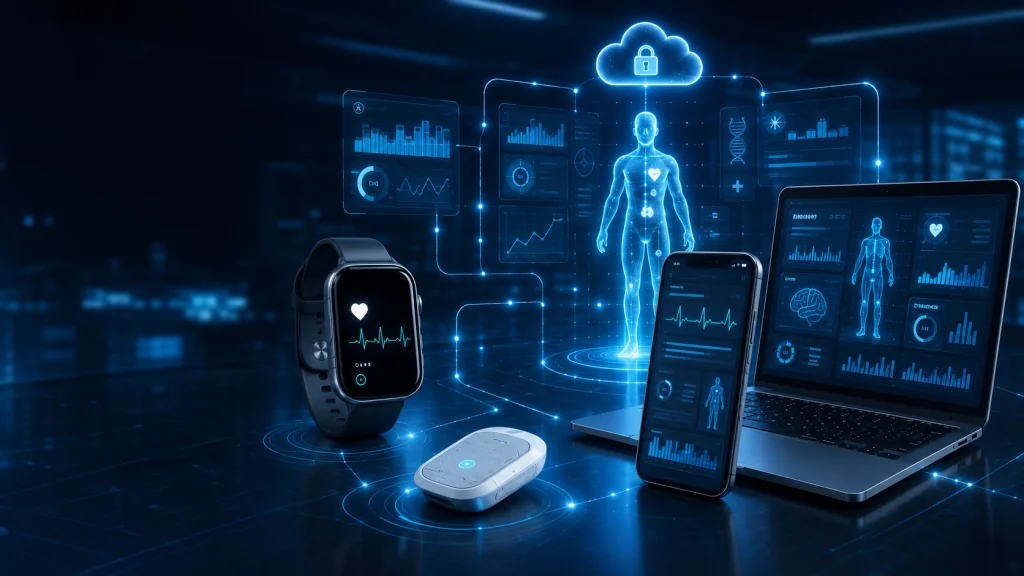
The Internet of Medical Things includes connected medical, wellness, and monitoring devices that collect, process, and transmit patient-related or device-related data.
These systems may operate in hospitals, clinics, rehabilitation centers, assisted-living facilities, or home-care environments.
Successful IoMT products require more than simply adding wireless connectivity. They must provide reliable data capture, secure communication, low-power operation, local data handling, remote diagnostics, and controlled lifecycle management.
Wearable Monitoring Devices
Wearable devices collect physiological, behavioral, or activity-related data over extended periods.
Depending on the application, they may monitor:
- heart rate or ECG-related signals;
- body temperature;
- blood oxygen saturation;
- movement, posture, or activity;
- sleep-related patterns;
- respiratory or other physiological parameters.
Wearable design typically combines low-power electronics, compact sensors, wireless connectivity, local buffering, battery management, and wearable-friendly mechanical integration.
The device must remain reliable during movement, charging cycles, intermittent connectivity, and extended operation.
Remote Patient Monitoring Systems
Remote patient monitoring systems collect patient-related data outside traditional bedside environments and make it available to clinicians, caregivers, or digital healthcare platforms.
A complete system may include:
- one or more sensing devices;
- a local gateway or mobile application;
- secure wireless communication;
- synchronized data transfer;
- configurable alerts;
- remote device-status monitoring;
- cloud or server integration;
- diagnostic and firmware update tools.
The embedded layer must ensure that measurements are captured consistently, stored during connectivity loss, and transferred without disrupting the user workflow.
Connected Home-Care Solutions
Home-care devices must operate reliably in environments where immediate technical support may not be available.
These products often require:
- simple and intuitive user interaction;
- clear visual, audio, or tactile feedback;
- robust connectivity;
- remote setup and support;
- automatic data synchronization;
- battery and device-status monitoring;
- fault detection and guided recovery;
- secure remote maintenance.
The product should remain understandable and dependable for patients and caregivers with limited technical experience.
Wireless Medical Sensor Nodes
Wireless medical sensor nodes are compact endpoints designed to capture patient-related, wellness-related, or environmental data and transmit it to a gateway or monitoring platform.
Because these nodes may operate without a full local user interface, they depend heavily on reliable autonomous behavior.
Their architecture may include:
- low-power sensing;
- Bluetooth, Wi-Fi, cellular, or proprietary wireless communication;
- local data storage;
- device identification and authentication;
- secure data exchange;
- battery-status monitoring;
- remote configuration;
- over-the-air firmware updates.
Careful power management, wireless performance, data integrity, and serviceability are essential when sensor nodes are deployed at scale.
A Practical IoMT Scenario
Consider a wearable monitoring device that must continuously capture physiological signals, store data during connectivity loss, protect patient-related information, and support secure firmware updates without interrupting normal operation.
These requirements cannot be addressed independently. They affect sensor selection, PCB architecture, signal processing, wireless communication, memory capacity, power consumption, cybersecurity, and validation strategy from the earliest development stage.
Together, IoMT solutions improve continuity of care, remote visibility, device manageability, and integration between physical healthcare products and digital information systems.
3. Assistive MedTech
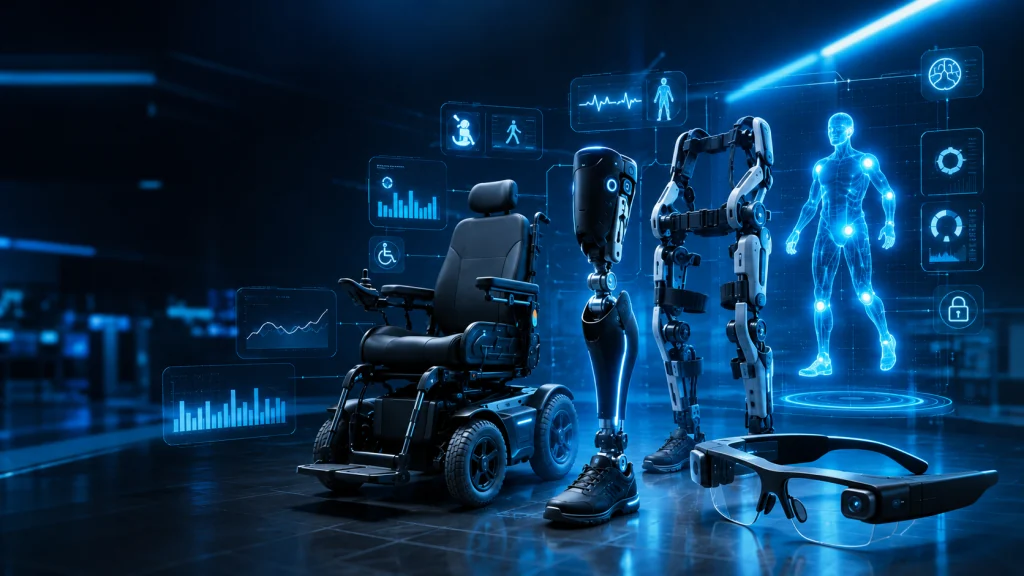
Assistive MedTech includes embedded devices and mechatronic systems designed to support mobility, rehabilitation, sensory assistance, accessibility, and human-device interaction.
Because these products operate in direct contact with users, they must provide predictable, safe, and intuitive behavior.
The engineering challenge is to coordinate sensing, actuation, control, feedback, ergonomics, and diagnostics while accounting for differences in user ability, movement, and environment.
Sensory Assistance Devices
Sensory assistance devices support or augment visual, audio, tactile, or other forms of interaction.
Examples may include:
- smart visual-assistance devices;
- audio guidance systems;
- tactile-feedback products;
- environmental-awareness devices;
- alerting and orientation systems;
- wearable assistive interfaces.
These solutions may combine cameras, microphones, proximity sensors, motion sensing, local processing, connectivity, and feedback mechanisms.
The embedded system must deliver information clearly and consistently without overwhelming the user.
Assistive Human-Machine Interfaces
Assistive human-machine interfaces enable users to control rehabilitation, mobility, or accessibility devices through inputs adapted to their physical and sensory capabilities.
Interfaces may include:
- buttons and switches;
- touchscreens;
- voice or audio interaction;
- gesture or motion controls;
- pressure- or force-sensitive inputs;
- visual, tactile, or audible feedback;
- mobile or caregiver-facing controls.
The interface should minimize unnecessary steps, prevent accidental activation, communicate system status clearly, and remain usable under real operating conditions.
Exoskeleton & Motion Assistance Electronics
Powered exoskeletons and motion-assistance systems require coordinated control of sensors, actuators, power electronics, and safety mechanisms.
The embedded architecture may need to process:
- joint position and movement;
- force or pressure;
- body orientation;
- gait and balance;
- actuator current and temperature;
- battery and power-system status;
- emergency-stop and fault conditions.
Real-time control, deterministic behavior, operational limits, diagnostics, and controlled shutdown mechanisms are especially important in systems that directly influence human movement.
Smart Rehabilitation Aids
Smart rehabilitation aids support guided exercises, movement assessment, therapy workflows, and progress tracking.
These products may include:
- movement and position sensing;
- force or pressure measurement;
- interactive feedback;
- exercise guidance;
- session data collection;
- configurable therapy programs;
- clinician- or caregiver-facing dashboards;
- connected device management.
By combining sensing, embedded control, and user feedback, rehabilitation devices can make therapy more measurable, repeatable, and responsive to individual progress.
Together, assistive technologies can improve accessibility, user independence, rehabilitation visibility, and the consistency of human-device interaction.
Key Engineering Challenges in Healthcare Device Development
Reliable Signal Acquisition
Healthcare devices depend on data quality. Sensor selection, analog front-end design, filtering, calibration, signal integrity, and embedded processing all influence whether measurements remain stable and usable under real operating conditions.
Power and Connectivity Trade-Offs
Portable, wearable, and wireless devices must balance operating time, communication range, data-transfer frequency, processing requirements, and physical size. Connectivity decisions directly affect battery life, usability, and system architecture.
Secure Device Lifecycle Management
Security must extend beyond encrypted data transfer. Connected devices may also require secure boot, device authentication, protected configuration, controlled firmware updates, event logging, and long-term vulnerability management.
Moving from Prototype to Production
A functional prototype is not automatically ready for deployment. The design must also account for component availability, testability, manufacturability, diagnostics, enclosure integration, validation activities, and future maintenance.
Why Hardware–Software Co-Design Matters
Healthcare products become operationally useful only when physical devices can measure, process, communicate, and act reliably.
This requires more than developing a PCB and firmware as separate workstreams. The complete embedded layer should be designed as one interconnected architecture:
- sensor selection affects signal processing and firmware;
- power requirements affect connectivity and device autonomy;
- enclosure design affects usability, thermal behavior, and antenna performance;
- connectivity choices affect security and data availability;
- update mechanisms affect serviceability and long-term support;
- hardware architecture affects testing, diagnostics, and manufacturing.
Addressing these dependencies early through hardware–software co-design helps reduce redesign, improve reliability, and create a clearer path from prototype to deployment.
For healthcare operators and product companies, this can provide practical benefits:
- earlier detection of abnormal readings and device faults;
- reduced manual intervention;
- improved visibility into device status;
- more reliable data capture and transfer;
- stronger security and update capabilities;
- easier maintenance and remote diagnostics;
- a more structured transition to production-ready hardware.
Where UnioTech Fits
UnioTech supports healthcare product teams with embedded hardware, firmware, sensing, connectivity, device interfaces, diagnostics, validation support, and secure connected-device architecture.
Our role may include:
- embedded system architecture;
- electronic schematic and PCB design;
- component and sensor selection;
- low-power device development;
- microcontroller and processor-based firmware;
- RTOS and embedded Linux development;
- wireless and wired connectivity;
- data acquisition and local processing;
- user-interface and display integration;
- motor, actuator, and control-system integration;
- secure boot and firmware update architecture;
- device diagnostics and event logging;
- prototype bring-up and debugging;
- preparation for testing and validation;
- DFM, DFT, and manufacturing preparation.
We can support a complete embedded product or work on a specific device layer that needs to be developed, redesigned, or integrated into a broader healthcare platform.
Structured Next Step
When a healthcare product lacks visibility, responsiveness, reliability, or scalability, a structured technical review is often the most effective starting point.
The review can help identify:
- the main hardware and firmware risks;
- sensing and connectivity requirements;
- the appropriate processing architecture;
- power and battery constraints;
- security and lifecycle needs;
- validation and diagnostic requirements;
- the practical path from prototype to field-ready hardware.
UnioTech can help determine which embedded architecture fits the product requirements, which device layer should be built or modernized, and how to move from a healthcare need to a reliable engineering solution.
Planning a medical, connected-health, monitoring, or rehabilitation device?
UnioTech can review your requirements, identify key technical risks, and propose a practical embedded architecture for prototyping, validation, and production preparation.